John Cooper Works Officially Rebranded


Here’s the official press release detailing the re-branding efforts of John Cooper Works we reported yesterday.
Official MINI Press Release: Premium quality, racing know-how and MINI feeling are now even more closely united: John Cooper Works continues success story with extended product range and new brand identity.
The roots shared by the names MINI and John Cooper Works reach back almost 50 years. Now a new chapter of their success story has been opened. Under the roof of MINI the entire product range designed for the driver with a specifically sporting ambition will bear the John Cooper Works label. Consequently, John Cooper Works will in future become an integral part of the MINI brand and represent more than ever before the epitome of ultimate driving fun for all MINI enthusiasts.
A visible sign of this repositioning is the newly devised brand logo which will be seen on all future John Cooper Works products. It is the guarantee for exceptional racing know-how, for an avid aspiration to achieve peak efficiency as well as for a deep understanding of the unconventional character and the outstanding quality demands expected of MINI. All John Cooper Works performance components are perfectly adapted to suit the MINI and are developed and manufactured at the highest premium level. They fulfil the high BMW Group standards with regard to reliability, workmanship and authenticity and are therefore also subject to the warranty conditions applicable to MINI.
The new constellation strengthens the alliance between MINI brand values and racing tradition even further. It is based on the revised 2007 version of the trademark agreements between MINI and John Cooper Garages, which have been intensively involved in the tuning of MINI models since the re-launch of the MINI brand. Chief executive Mike Cooper will continue to operate as the connecting link between the two companies in order to guarantee the mutual transfer of racing passion and MINI feeling on a long term basis.
In doing this he is following in his father’s footsteps. The legendary Formula 1 design engineer John Cooper already introduced his first refined version of the Mini as early as 1961.The Mini Cooper had been born. Only two years previously a mini car created by Alec Issigonis had revolutionised everyday transportation. Now John Cooper had provided racing fans with a vehicle that was setting new standards in agility and driving fun. In the following decades the name Cooper became synonymous worldwide with the ultimate driving fun experienced in a Mini. The fact that it was this new kind of compact car that had inspired the two-time Formula 1 world champion to build outstanding sports cars was convincing proof of the Mini’s qualities. The unique driving experience that was associated with the Mini fascinated Cooper so much that he was prompted to refine it to perfection, a fact that excites every sports car fan to this day.

Today the brand John Cooper Works stands for optional equipment and accessories, vehicle concepts and small-lot production, providing MINI enthusiasts with the opportunity to live out their passion for motor sports. Fitted with the John Cooper Works Tuning Kit, the MINI Cooper S becomes a power machine that need not fear comparison with well reputed sports cars. The
tuning kit comprises a sports air filter, sports silencer and modified engine electronics, facilitates a boost in output to 141 kW/192 bhp and provides both a visual and acoustic differentiation.
The highlights of the John Cooper Works accessory range include the aerodynamics package, sports suspension with red lacquered springs, a wide choice of alloys and a high performance braking system with perforated brake discs. Moreover, a strut brace for the engine compartment, mirror caps in a carbon finish and side indicator surrounds – better known as side scuttles – featuring a sporty looking grid design are available. The list of features providing the interior with a racing car ambience includes interior trims, handbrake lever and gear shift knob in a carbon decor. John Cooper Works sport seats, Alcantara/Carbon sports steering wheel and gear shift indicator, which signalises the optimum time to change gear for maximum acceleration, are the perfect ingredients for an ultimate driving experience.

The new racing car for the MINI CHALLENGE 2008 also bears the famous label. The MINI John Cooper Works CHALLENGE is a racing machine that is the result of decades of experience in building racing cars – an output of 154 kW/210 bhp (temporary values) and equipped with many components developed exclusively for the racetrack. Drivers of the MINI CHALLENGE can redefine the limits of their capabilities, bringing even more excitement to the already successful club sport series. All John Cooper Works products are designed to meet exceptionally high quality standards. Down to the smallest detail they must be able to cope not only with the extreme conditions prevailing on the racetrack, but also fulfil the extensive requirements of everyday traffic in terms of functionality, design, reliability and durability. The work of experienced engineers as well as the countless test kilometres on the racetrack and on the road ensures that these requirements are fulfilled. Consequently, the brands MINI and John Cooper Works stand for the promise of quality, the significance of which is unique in the MINI’s competitive environment.

No other name is so closely associated with the racing legend behind the MINI as the name John Cooper. Along with the designer of the classic Mini, Sir Alec Issigonis, he has made a decisive contribution in creating this unique vehicle’s character that still remains alive to this day. The basis of this stems from a close friendship between the two men. Long before Alec Issigonis created the classic Mini, he fostered a close relationship with the ex racing driver and well-known British automobile designer. Cooper was regarded as being equally talented, ambitious and zestful. At the early age of twelve, John Cooper, who was born in 1923 in Surrey, England, showed the public what he was made of when he drove a racing car built by his father, with whom he founded the Cooper Car Company in 1946. The two began building racing cars, at first for Formula 3 racing. The Cooper Car Company soon advanced to become the most successful supplier of professional racing cars, taking English teams and drivers to the top of Formula 1 racing.
With their concept of a mid-engine sports car Charles and John Cooper set a ground-breaking trend in 1955 for the entire industry. During the years 1959 and 1960 racing cars built by Cooper won both the constructors’ and the drivers’ title in the Formula 1 world championship featuring mid-engine vehicles. The concept was a success, with other manufacturers following the example in the years to come. Soon all Formula 1 series cars were built according to this principle. Nevertheless, Cooper was still able to maintain the status of having the most successful brand in Formula 1 racing during the fifties and sixties. During the course of time almost every motor sports legend had driven a Cooper, whether Jack Brabham, Bruce McLaren or Jochen Rindt.
Contact with Alec Issigonis had already been established when John Cooper was having engines built at the British Motor Corporation (BMC) which he employed in his Formula Junior racing cars. For this reason Cooper was familiar with the history of the development of the Mini that Issigonis was to design for BMC. This company had been established through the merger of British car manufacturers, its brands including Austin, Morris, MG and Wolseley.
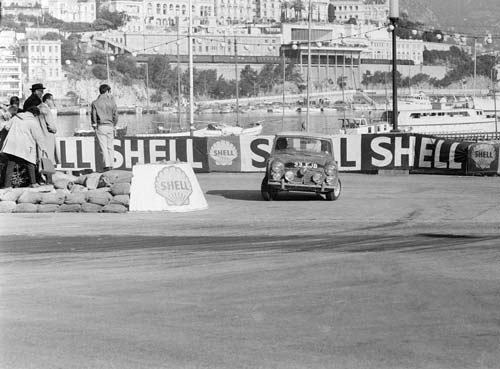
John Cooper was completely fascinated by the emergence of the Mini. He was convinced that the innovative vehicle concept featuring the “wheel on each corner” principle, the short overhangs and the overall flat appearance was exactly what he had been searching for over many years – the basis for a superior racing machine. As early as 1959, the year in which the Mini debuted, he sent his driver Roy Salvadori with the first Mini Cooper, a one-off, to Monza to be put to the test for the first time. In 1960, just six months after the Mini’s debut, six works cars equipped by John Cooper celebrated their first success d’estimes at the Monte Carlo Rally.
The Mini’s creator Issigonis had a rather more low key approach than racing pioneer Cooper to the plan to upgrade the car, which was initially designed as a spacious, cheap and economical means of transportation for everyone, to a sports version. At first, Issigonis turned down Cooper’s proposal to derive a GT model from the Mini. However, Cooper was not put off by this and contacted BMC chief George Harriman who finally agreed. With a limited production of 1000 Mini Coopers, the public’s reaction to such a vehicle concept was to be tested. With modifications such as a higher stroke with smaller bores, larger inlet valves, twin carbs, drilled outlet port and a reinforced crankcase housing the first Mini Cooper delivered 55 bhp and a top speed of around 130 km/h. Transmission ratio was geared to the sporting potential, disc brakes on the front wheels ensured adequate deceleration values.
The result of these efforts finally convinced Issigonis. He immediately joined John Cooper to work on a further step in improving performance. For the Mini Cooper S the bore was enlarged to 70.6 mm, this being close to the limit of what was possible. Displacement of 1071 cc remained below the limit of 1 100 cc valid for the targeted racing class, engine speed was, however, most impressive. The new engine delivered 70 bhp at 6 200 rpm, top engine speed being reached at 7 200 revs. This version was also equipped with revised brakes, braking power being servo-assisted.
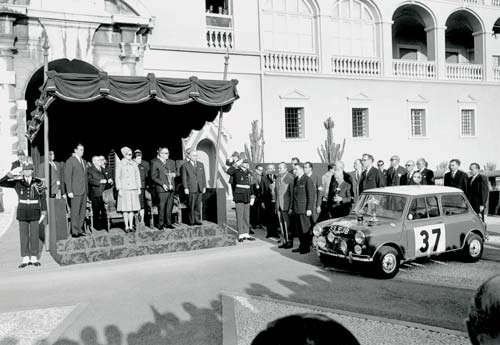
The foundation for sensational successes in motor sports had been laid. It was 1962 when the Mini Cooper S caused a stir in Monte Carlo for the first time. With Rauno Aaltonen from Finland at the wheel the agile little car in its role as David banished a Goliath Phalanx to the position behind him in his slipstream. Just 3 kilometres from the finish Aaltonen, who was in the lead, misjudged a bend and finished the race with a rollover. However, he already made up for his misfortune the following year. Aaltonen drove his Mini Cooper S across the finishing line to become class winner and third in the overall ranking.
And things were to get even better. In the rally winter of 1963/1964 the Mini Cooper S was literally bursting with power compared to its predecessor. In a spectacular race at the Monte, Paddy Hopkirk seized first place in the overall ranking driving a Mini with the newly designed racing engine, beating far stronger competition. With a spectacular bang the little sprinter had become a motor sports legend. The following year Timo Mäkinen from Finland together with his co-pilot Paul Easter repeated the triumph at the Monte. He was the only driver competing to master thousands of kilometres without conceiving one single penalty point, even although up against the most adverse conditions in the snow and ice of the French Alps. Only 35 of 237 cars that had been on the starting field actually made it over the finishing line at this rally, three of them bore the logo Mini Cooper S.
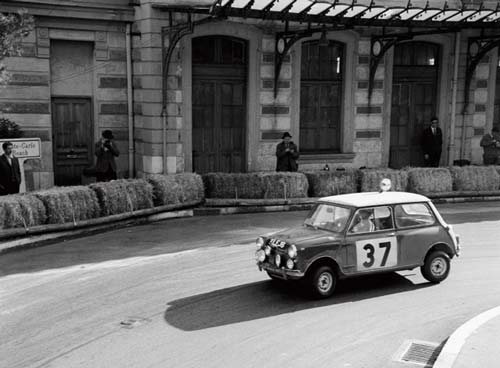
The following year saw the hat-trick. The four competing Cooper teams went well ahead of the field, with drivers Timo Mäkinen, Rauno Aaltonen and Paddy Hopkirk achieving an incredible result. They crossed the finishing line as first, second and third. However, this feat was followed by bitter disappointment. The three winners were deprived of their success, as the rally commissioners agreed that the four additional headlamps mounted in front of the radiator grille did not comply exactly with French registration conditions. Indeed, this decision had little effect on the spectators’ enthusiasm for the three Mini drivers. Hopkirk, Aaltonen and Mäkinen went down in the annals of the Monte Carlo Rally as “the three musketeers”. And just a year later Rauno Aaltonen was able to enjoy an even more enthusiastic celebration to mark his third Monte Carlo victory in a Mini Cooper S. This time there was nothing wrong with his vehicle.
However, the Mini was not only put on a brilliant performance at rallies. In the sixties it was able to seize victory many times on the road. With its overall sporting record it became the outstanding racing car of the whole decade. In addition to its career in racing sport, the John Cooper version of the Mini Cooper was exceptionally successful from 1961 to 1971 in terms of sales. Even in those days the names Mini and Cooper were internationally associated with unmatched driving fun. Moreover, tuning kits developed by Cooper for Mini series production vehicles were in great demand. Right from the start no other car offered more sporting features for less money and more driving fun within a confined space.

The traditional alliance between Mini and John Cooper also became a crucial factor for the new version of the small car. In 1999 Mike Cooper was invited by the BMW Group to incorporate the know-how of the family business enterprise, which now operates as John Cooper Garages, into the project MINI. Mike Cooper continued his father’s work with the same fervidness. Like John Cooper had once done, he pondered on a performance-enhanced version long before the launching of the MINI in the year 2001. And even then it was his dream to get MINI back on the racetrack. He started by organising the John Cooper Challenge for performance-enhanced series production vehicles in England – with the starting field fully booked within a very short time.
John Cooper was not able to witness the market launch of the modern MINI. He died in the year 2000 at the age of 77. The name John Cooper Garages remained. Today it stands, and will in future stand, for a company with a long-standing tradition which has continued to convince over three generations through the use of outstanding know-how and highest quality awareness in the field of auto tuning, as well as being synonymous with exceptional personalities who, for decades, have set milestones in motor sports.

